
Ask any regular cyclist where the coffee shop is and they'll tell you without looking it up. Ask them how long the route is without the café stop and they'll look at you like you've asked a strange question. The café stop isn't part of the ride. For most cyclists, it is the ride.
This isn't an accident, and it's not just about caffeine. The relationship between cycling and coffee is woven through the sport at every level, from the professional peloton to the Sunday morning club run. Understanding why it exists tells you something real about how cycling works as a culture.
Where It Started
Coffee has been part of professional cycling for over a century. Early road racing took place over distances that would end careers today, and riders needed every advantage available. Coffee, with its stimulant effects, was one of the first widely used legal performance aids in the sport.
Before modern sports nutrition arrived with gels, powders, and precisely calibrated electrolyte drinks, the café stop was a functional part of racing. Riders refuelled, warmed up, and recovered at cafés along the route. The tradition was built into the structure of the sport before it became a culture.
As professional cycling modernised and nutrition became more scientific, the café stop moved out of the race and into the training ride. And from the training ride, it moved into the fabric of how recreational cyclists organise their time on the bike.
The Social Architecture of a Café Ride
The café ride has a specific structure that most cyclists understand intuitively, even if they've never articulated it.
You ride out. The pace is usually solid but not punishing. There's talking, a bit of banter, the odd dig on a climb that someone swears wasn't meant to be an attack. Then you get to the café, sit down, order coffee and something to eat, and the conversation slows to match the pace. Someone talks about their new wheels. Someone else mentions a route they want to try. The ride debrief happens organically, over flat whites and banana bread.
Then you ride home. Usually a bit slower, because the legs are fuller and nobody's pretending it's a race anymore.
That structure, out hard, stop properly, home easy, creates a ride with a beginning, a middle, and an end. It also creates a reason to push on the way out and permission to ease off on the way home. The café stop is the hinge point of the whole thing.
Why Coffee Specifically
Tea works fine as a hot drink. A juice or soft drink gets the sugar and fluid in. But coffee is what cyclists order, almost universally.
Part of this is practical. Caffeine is a proven performance aid with a solid body of research behind it. It reduces perceived effort, improves sustained power output, and delays fatigue. A double espresso at the 60km mark of a long ride has a measurable effect on how the back half of that ride feels.
Part of it is cultural. Coffee, like cycling, has an entire vocabulary and set of rituals built around it. The kind of coffee you drink, the café you choose, the way you order: all of it signals something about who you are and what you know. Both pursuits reward the person who cares about the details, and both have accumulated a density of opinion and preference that can fill hours of conversation.
And part of it is that a well-made flat white at the 60km mark of a ride tastes genuinely exceptional in a way that's hard to replicate in any other context. Effort, timing, and good coffee are a combination that doesn't need further explanation.
The Kit You Wear to the Café
There's an informal code around what you wear on a café ride, and it's worth understanding if you're newer to the sport.
Race kit at the café is completely normal. The cycling culture around coffee leans into the performance side of the sport, not away from it. Showing up to the café stop in a proper cycling jersey after a hard ride out is standard, not excessive.
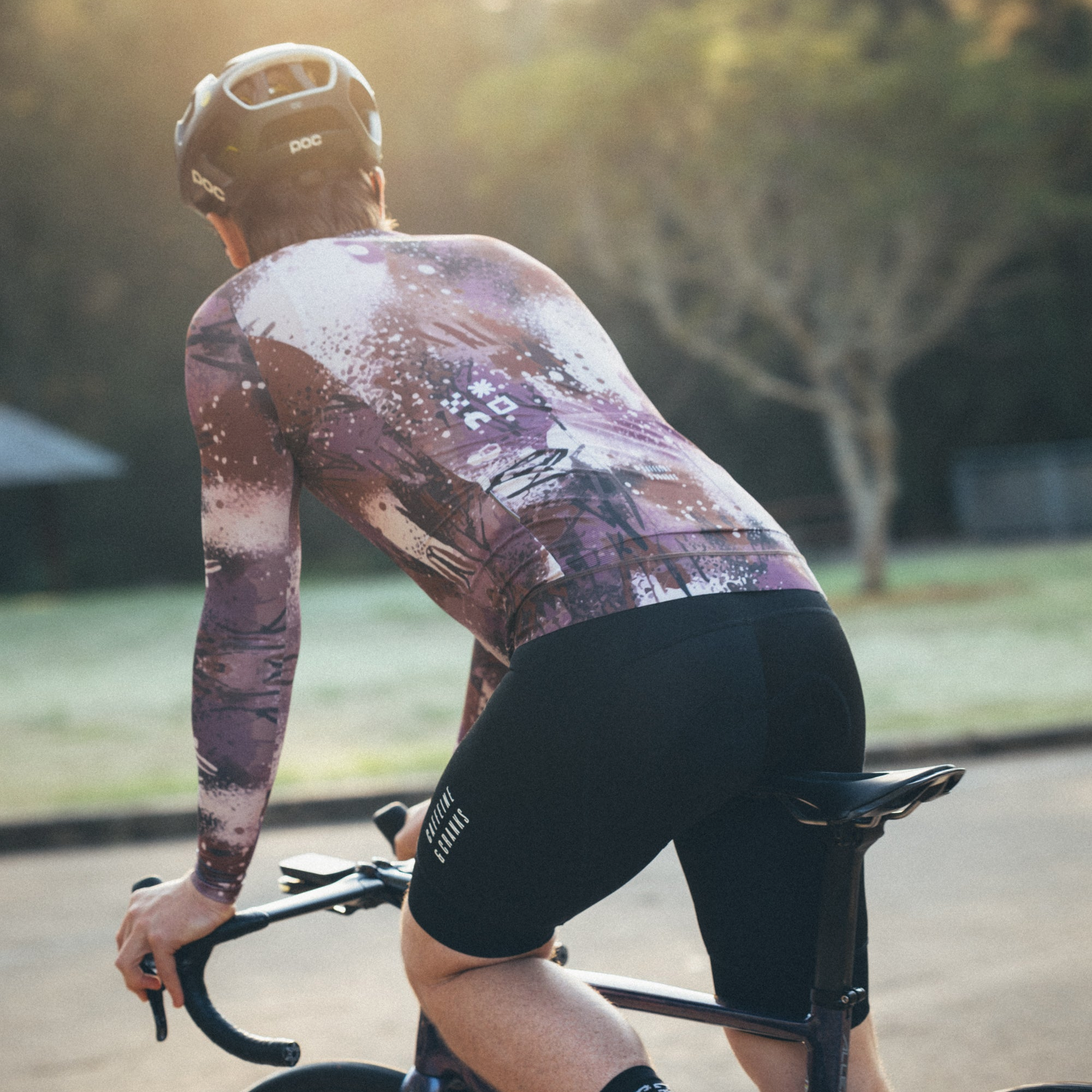
Caffeine and Cranks jerseys are cut race fit by default: snug and aerodynamic in the riding position, close to the body without loose fabric. If you'd prefer a slightly more relaxed feel for café rides over aggressive training sessions, sizing up one gives you that without compromising on fabric quality or the pocket layout you actually need to carry your stuff. Check the sizing guide to find your fit before ordering.
The thing that actually matters at the café is that your kit fits properly and holds up after repeated use. A jersey that looks sharp when new but loses its shape after a season of washing isn't doing what you need it to do. The Caffeine and Cranks jersey range is built to keep its structure ride after ride, wash after wash.
The Language of Café Riding
Australian cycling culture has its own vocabulary around café rides, most of which you'll pick up quickly once you're riding with a club.
The coffee stop: the point in the ride where you stop at a café. Can be a single café or a rotating list depending on the group.
The espresso ride: a shorter, punchier ride built around a café destination. Typically 60 to 90 minutes out, stop properly, 60 to 90 minutes home.
The café racer: a rider whose café game is stronger than their legs. Usually said affectionately. Usually.
Sitting in: on the way to the café, sitting in the bunch rather than taking turns at the front. Saving legs for the sprint to the coffee machine.
These terms are part of how cycling culture communicates about itself. Knowing them makes conversation easier and makes you faster to fit into a new group.
Finding Your Café Crew
The café ride is one of the best entry points into club cycling for riders who aren't sure they want to race or do structured training. Most clubs run a social or café ride on weekend mornings that's open to all abilities, lower in intensity than the A-grade bunch, and built around a café stop midway.
If you're looking to meet other cyclists in your area, the café ride is a better starting point than showing up to a criterium with no idea who anyone is. The pace is manageable, the conversation is easier because there's a natural stopping point, and the shared experience of good coffee after a solid ride creates the kind of easy social connection that's hard to manufacture any other way.
For what to wear when you go, the Caffeine and Cranks range has you covered from the first ride to the hundredth.
The Short Version
Coffee and cycling go together because they share the same underlying logic. Both reward effort. Both have accumulated culture and ritual around them. Both are better shared with other people who take them seriously.
The kilometres are the reason you went out. The café is why you go again next week.
Read more
Canberra is the only Australian capital that gets genuinely cold. Minus three at 6am in July isn't unusual. Frost on the grass across most of the inner suburbs for six or seven weeks of the year. T...

Ordering custom cycling kit for your club or team? What to know about minimums, timelines, and getting the fit right across a group.